
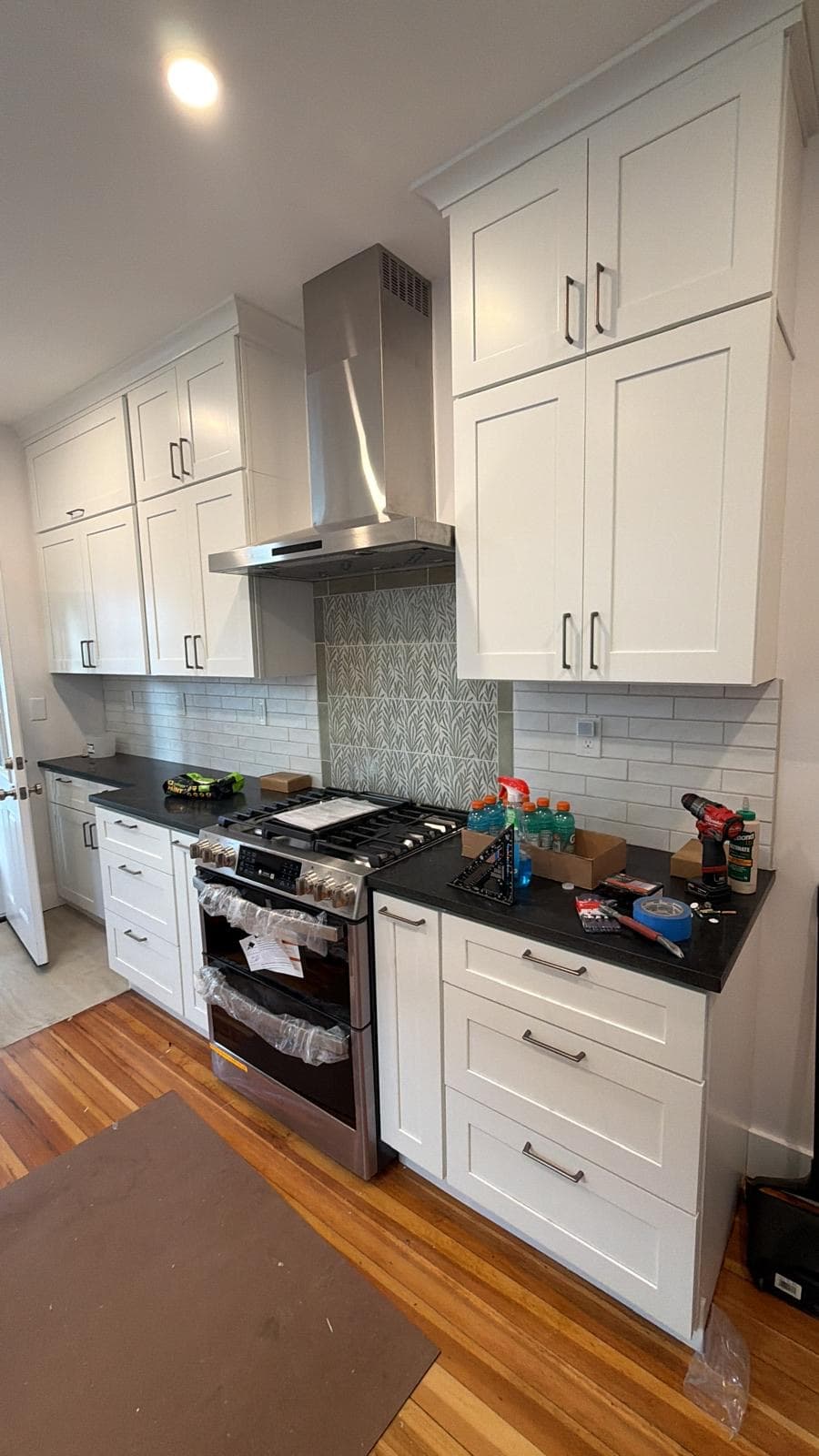
If you are planning a kitchen remodel in Massachusetts, the first question is almost always the same: what is this going to cost me? It is a fair question, and the honest answer is that it depends on the size of your kitchen, the materials you choose, and how much of the layout you want to change. That said, you do not have to fly blind. There are real market ranges for the Greater Boston area that give you a solid starting point.
This 2026 guide breaks down what most homeowners in Massachusetts actually pay, from a light cosmetic refresh to a full high-end renovation. We will walk through the cost tiers, the line items that drive your budget up or down, and the local factors (permits, labor, older homes) that matter here in the Boston area.
New Power Construction is a family-run general contractor based in Malden, MA, led by finish carpenter Reggie Torres, who has been building and remodeling kitchens across Greater Boston for 20 years. Every number below is a rough guide, not a quote. For an exact price on your specific kitchen, a free in-home estimate is always the best next step.
The Short Answer: 2026 Kitchen Remodel Cost Ranges in Massachusetts
As a rough guide, most kitchen remodels in the Greater Boston area fall into three tiers. A minor or cosmetic remodel (new countertops, refreshed or refaced cabinets, updated hardware, backsplash, and paint, with the existing layout kept) typically runs about $18,000 to $35,000. This is the sweet spot for homeowners who like their kitchen footprint but want it to look and function like new.
A mid-range remodel (new semi-custom cabinets, quartz or granite counters, new flooring, updated lighting and plumbing fixtures, and some minor layout tweaks) typically lands between $40,000 and $75,000 in Massachusetts. This is the most common tier for a full gut and refresh in a standard sized kitchen.
A high-end or luxury remodel (custom cabinets, premium stone, high-end appliances, moving walls or plumbing, and a fully reconfigured layout) commonly starts around $80,000 and can climb well past $130,000, especially in larger homes or when structural work is involved. Where your project lands inside these ranges comes down to the details, which we break down next.
What Actually Drives the Price
Cabinets are usually the single biggest line item, often 25 to 35 percent of the total budget. Stock cabinets are the most affordable, semi-custom offers a good balance of style and cost, and full custom cabinetry (built and finished to your exact space) sits at the top. As finish carpenters, this is an area where quality craftsmanship really shows over the years.
Countertops, appliances, and flooring are the next big movers. Laminate keeps costs down, while quartz, granite, and natural stone add both cost and value. Appliances can range from a few thousand dollars for a solid mid-range package to well over $20,000 for a premium suite. The bigger the kitchen, the more square footage of everything, so size scales the whole budget.
Layout changes are where budgets quietly grow. Keeping your plumbing, gas, and walls where they are is far cheaper than moving them. The moment you relocate a sink, knock down a wall, or add an island with plumbing, you bring in more electrical, plumbing, and sometimes structural work, which adds both labor and permit costs.
Local Factors That Affect Cost in Greater Boston
Massachusetts labor rates run higher than the national average, and the Greater Boston market is one of the more expensive metros in the country. That is reflected in the ranges above, so be cautious about national cost calculators that quote lower numbers; they often do not match what you will actually pay in Malden, Burlington, or the surrounding towns.
Many homes around here are older, and that matters. Kitchens in older Boston-area homes often hide surprises behind the walls: outdated wiring that needs to be brought up to code, aging plumbing, uneven floors, or even knob-and-tube wiring. A good contractor plans for the possibility and talks it through with you upfront so it does not become a mid-project shock.
Permits are part of the picture too. Most kitchen remodels that involve electrical, plumbing, or structural work require permits from your local building department, and inspection requirements vary by town. A licensed general contractor handles the permitting and inspections for you, which keeps the project legal, safe, and clean for a future home sale.
Where You Can Save (Without Cutting Corners)
The single biggest way to save is to keep your existing layout. If the current footprint works, leaving the plumbing and walls in place can save many thousands of dollars while still giving you a kitchen that looks brand new.
Cabinet refacing or refinishing is another smart move when the existing cabinet boxes are structurally sound. Instead of full replacement, you get new doors, drawer fronts, and finishes at a fraction of the cost. Mixing materials also helps: pairing a stunning quartz island with a more budget-friendly counter on the perimeter, for example, gives you a high-end look without a full high-end price.
Finally, plan the whole project before demolition starts. Most cost overruns come from mid-project changes, not from the original plan. Nailing down your cabinets, finishes, and appliances upfront keeps the budget predictable and the timeline tight.
Where the Money Goes: A Typical Budget Breakdown
For a mid-range Massachusetts kitchen remodel, the budget usually splits along familiar lines. Cabinetry tends to take the largest share, followed by labor and installation, then countertops, then appliances. Flooring, lighting, plumbing fixtures, backsplash, paint, and permits make up the rest.
As a rough guide, expect cabinets to be roughly 25 to 35 percent, labor around 20 to 35 percent, countertops around 10 percent, and appliances around 10 to 15 percent, with the remainder spread across finishes, fixtures, and permits. These percentages shift with your choices, but they help you sanity check any quote you receive.
One tip: always keep a contingency of about 10 to 15 percent of your total budget set aside, especially in older homes. It covers the surprises that only show up once the walls are open, and it means an unexpected wiring or plumbing fix does not derail the whole project.
How Long Does a Kitchen Remodel Take?
Timeline and budget go hand in hand, since longer projects mean more labor. A cosmetic refresh can often be done in two to three weeks. A standard mid-range remodel typically takes about four to eight weeks from demolition to final walkthrough.
A high-end remodel with custom cabinetry, layout changes, or structural work can run eight to twelve weeks or longer, largely because custom cabinets and specialty materials have longer lead times. Ordering those items early is one of the best ways to keep the schedule on track.
The most reliable timeline comes from a contractor who has seen your actual space. Older Greater Boston homes in particular can add time once hidden conditions come to light, so a walkthrough gives you a far more accurate estimate than any online tool.
Getting an Accurate Number for Your Kitchen
The ranges in this guide are meant to help you plan and budget, not to serve as a quote. The only way to know what your kitchen will actually cost is to have someone measure the space, review the condition of what is behind the walls, and price out the exact materials and layout you want.
New Power Construction offers free in-home estimates across Malden, Burlington, and the surrounding Greater Boston communities. Reggie and the team will walk your kitchen, listen to what you want, flag anything that could affect the budget, and give you a clear, honest number with no pressure. When you are ready to turn a ballpark into a real plan, that free estimate is the place to start.